"Where Creativity Meets Confidence – For Kids, Adults & Lifelong Learners!"
What Learning Through Play Really Looks Like (Ages 3–5)
Discover what learning through play really looks like for ages 3–5, with real examples that support math, STEM, SEL, and everyday learning.
Latasha Milton
1/1/20263 min read
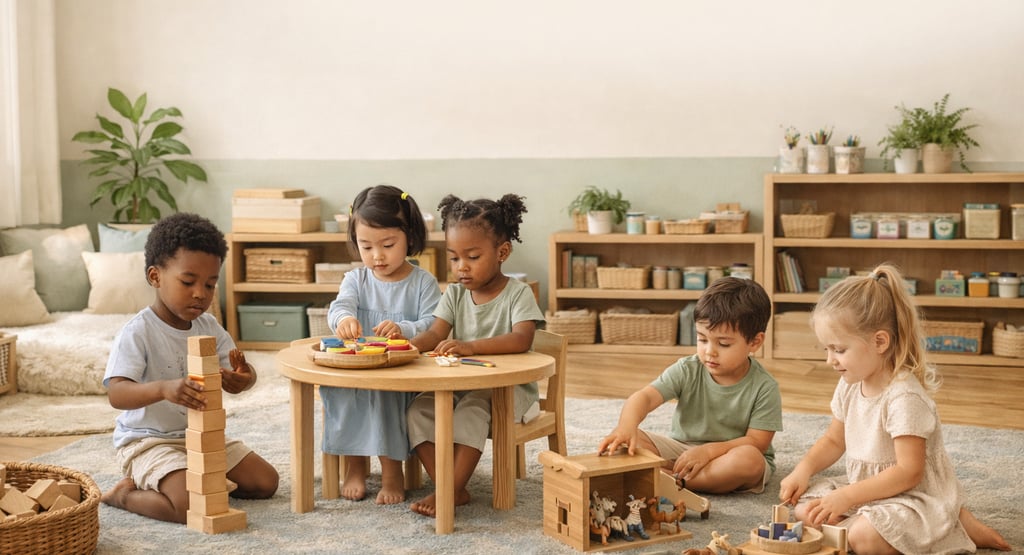
If you’ve ever watched your child build the same tower again and again, talk to toys as if they’re real, or dump everything out just to put it back—then wondered, “Are they actually learning?”—you’re not alone.
Learning through play is often misunderstood because it doesn’t look like what many adults expect learning to look like. There are no worksheets, no visible “lessons,” and no clear finish line. And yet, play is one of the most powerful learning tools young children have.
The problem isn’t play.
The problem is that no one has shown us what real learning through play actually looks like in action.
Let’s change that.
First, Let’s Clear This Up: Play Is Not the Opposite of Learning
One of the biggest misconceptions about play-based learning is that play happens instead of learning.
In reality, play is the vehicle through which learning happens for children ages 3–5.
Young children are not wired to learn through abstract instruction. Their brains develop through:
Movement
Repetition
Sensory input
Trial and error
Emotional safety
Play provides all of this at once, but play-based learning is not random. It has patterns, signals, and developmental markers. You just have to know what to look for.
What Learning Through Play Actually Looks Like (In Real Life)
Below are real, everyday examples of play and the learning underneath that most adults miss:
Example 1: Building the Same Thing Over and Over
What it looks like:
Your child builds a tower. It falls. They build it again. And again. And again.
What’s really happening:
Problem-solving
Early engineering thinking
Cause and effect
Persistence
Spatial awareness
This repetition isn’t boredom. It’s mastery in progress. When a child repeats the same play, they’re refining their thinking, not wasting time.
Example 2: Pretend Play That Seems “Off-Topic”
What it looks like:
A child pretends a block is a phone, a spoon is a microphone or a stuffed animal is a teacher.
What’s really happening:
Language development
Symbolic thinking
Emotional processing
Perspective-taking
Story structure
Pretend play is how children practice understanding the world and their place in it. This is especially important for children processing big feelings, change, or grief.
Example 3: Sorting, Dumping, Re-Sorting
What it looks like:
Your child dumps toys out, sorts them, mixes them back together, then sorts again.
What’s really happening:
Early math skills
Classification
Pattern recognition
Focus and attention
Executive functioning
This is the foundation for math, not numbers on a page.
Example 4: “Helping” With Everyday Tasks
What it looks like:
Your child insists on helping with laundry, cooking, or cleaning, even though it takes longer.
What’s really happening:
Sequencing
Vocabulary growth
Fine motor development
Responsibility
Confidence and belonging
Real-life participation is one of the most overlooked learning tools we have.
What Adults Often Do That Interrupts Play-Based Learning
Most adults don’t reject play. They accidentally interrupt it. Here are common well-meaning mistakes:
Turning play into a lesson too quickly
Asking too many questions
Correcting instead of observing
Rushing to show the “right” way
Ending play before the child is done
Learning through play works best when adults support the process, not control it.
What Your Role Actually Is (And What It’s Not)
Your role is NOT:
To quiz
To teach constantly
To explain everything
To make play look educational
Your role IS:
To notice
To narrate occasionally
To provide materials
To create emotional safety
To allow time
Sometimes the most powerful thing you can say is: “Tell me about what you’re making.”
What Learning Through Play Looks Like by Age (3–5)
Ages 3–4:
Short bursts of play
Heavy sensory exploration
Repetition
Big emotions
Emerging language
Ages 4–5:
Longer focus
More complex pretend play
Early planning
Growing problem-solving
Strong curiosity
Both stages matter. Neither should be rushed.
How You Know Learning Is Happening (Without Testing)
Learning through play is working when you notice:
Longer engagement over time
New language during play
Increased independence
Willingness to try again
More emotional regulation
Progress is subtle, but it’s real.
A Reframe Every Adult Needs
If learning feels quiet…
If it looks messy…
If it doesn’t produce a worksheet…
It may actually be exactly right. Play is not preparation for learning. Play is learning.
Final Thought for Parents, Teachers, and Homeschool Families
You don’t need more activities.
You don’t need better supplies.
You don’t need to turn play into school.
You need permission to trust what’s already happening. When children play freely, safely, and with support, they are building the foundation for everything that comes next.
Want more guidance like this? Explore our play-based learning resources designed to support the whole child—mind, body, and heart.