"Where Creativity Meets Confidence – For Kids, Adults & Lifelong Learners!"
My Child Won’t Sit Still. Is Learning Through Play Enough for Preschool?
Worried your child won’t focus in preschool? Learn why learning through play builds attention, confidence, and skills without forcing sitting still.
THE WHOLE CLASSROOMLEARNING THROUGH PLAY
Latasha Milton
1/5/20262 min read
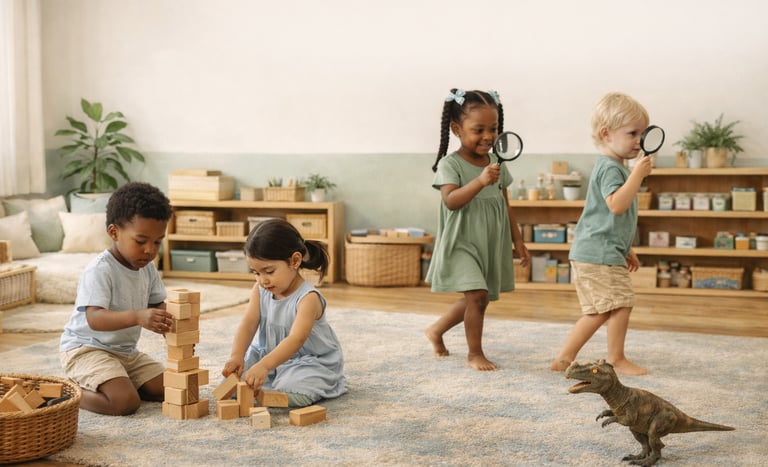
If you’ve ever said, “My child just can’t sit still,” you’re not alone. It’s one of the most searched concerns among parents, teachers, and homeschool families of preschoolers and it often comes with worry:
Are they falling behind?
Should they be able to focus longer by now?
Is play really enough if they won’t sit and listen?
Let’s start with the most important truth:
Most preschool-aged children have a difficult time sitting still. And that doesn’t mean learning isn’t happening.
Why “Difficulty sitting still” Is So Common in Preschool
Preschoolers (ages 3–5) are in a stage of rapid brain and body development. Their learning systems are built for:
Movement
Exploration
Sensory input
Short bursts of focus
Repetition
Sitting still for long periods requires brain skills that are still developing, especially attention regulation and impulse control. So, when adults expect preschoolers to focus the way older children do, frustration follows on both sides.
What “Focus” Really Looks Like at Preschool Age
Many adults imagine focus as:
Sitting quietly
Looking at a worksheet
Listening without moving
But for young children, focus often looks very different.
Focus might look like:
Building the same structure repeatedly
Moving while listening
Talking through what they’re doing
Switching activities and returning later
Engaging deeply for short periods
These are signs of developing attention, not failure.
Why Learning Through Play Supports Focus Better Than Sitting Still
Learning through play works with a child’s brain, not against it.
Play-based learning:
Allows movement while thinking
Builds attention gradually
Reduces stress and pressure
Strengthens self-regulation
Increases motivation and engagement
When children feel safe and interested, focus naturally increases over time.
What Happens When We Push Sitting Still Too Early
When young children are forced to sit still beyond their developmental readiness, it can lead to:
Increased frustration
Avoidance of learning
Emotional shutdown
Negative self-beliefs (“I’m bad at school”)
This doesn’t build focus. It teaches children that learning is uncomfortable.
What Learning Through Play Looks Like for a Child Who “Won’t Focus”
Here’s what real learning might look like for a child who struggles to sit still:
🔹 Building While Moving
A child builds with blocks, knocks them down, and rebuilds is learning:
Problem-solving
Persistence
Cause and effect
🔹 Pretend Play With Lots of Talking
A child acts out scenarios with toys is learning:
Language
Emotional expression
Social understanding
🔹 Short Bursts of Engagement
A child plays intensely for 5–10 minutes, then moves on. This is developmentally appropriate focus.
Over time, these bursts naturally lengthen.
How Learning Through Play Builds Focus Over Time
Play builds focus by:
Strengthening self-regulation
Encouraging intrinsic motivation
Allowing children to practice attention without pressure
Focus develops gradually, not through force, but through experience.
What You Can Do Right Now (Without Forcing Sitting Still)
If your child won’t sit still, try these play-based supports:
Offer activities that involve hands-on movement
Allow frequent movement breaks
Let children talk while they play
Follow their interests
Reduce unnecessary demands to “sit and listen”
Focus grows best when children feel understood.
When to Pause the Worry...
If your child:
Engages deeply in play
Is curious and exploratory
Communicates ideas
Shows learning through actions
Then learning is happening, even if it doesn’t look traditional.
A Gentle Reframe Every Adult Needs
A child who won’t sit still is not a problem to fix. They are a child whose brain is still learning how to focus and play is one of the best teachers they have.
Final Thought for Parents, Teachers, and Homeschool Families
Learning through play is not a backup plan for children who won’t focus. It is a developmentally appropriate, brain-based approach that helps children grow into focused learners, at the pace their brains are ready for.
You don’t need to rush stillness.
You don’t need to force focus.
You need to trust development.
Looking for play-based tools that support focus without pressure? Explore our learning-through-play resources designed for preschool and kindergarten learners.